Infinite Build
UtilityScore: Building a National-Scale Data Platform
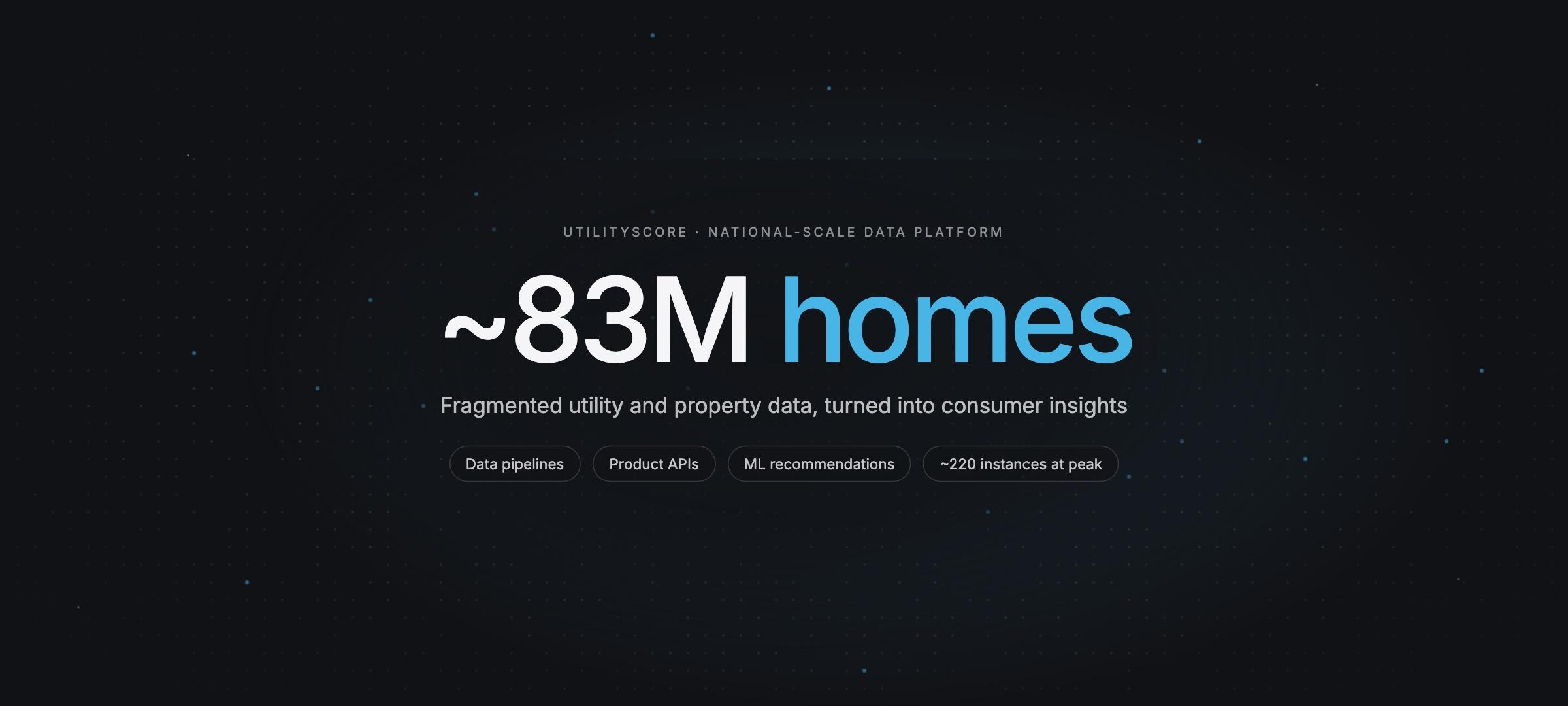
Transforming fragmented utility and property data into actionable insights for approximately 83 million U.S. homes.
UtilityScore set out to turn fragmented utility, property, and energy data into a consumer product at a scale few startups would attempt. Supporting approximately 83 million U.S. homes as part of a Zillow partnership required more than collecting information. It required an engineering platform capable of processing large volumes of inconsistent data, generating meaningful insights, and delivering them through a consumer-facing product.
Infinite Build's technical leadership helped turn that ambition into a scalable platform through data-processing pipelines, product APIs, and machine-learning-driven recommendations.
Project Overview
- Client: UtilityScore
- Industry: Real Estate Technology / Energy
- Engagement: Product Engineering & Technical Leadership
- Coverage: ~83 million U.S. homes
- Peak Infrastructure: ~220 cloud instances
The Challenge: Making Fragmented Data Work at National Scale
Utility and property data are distributed across different providers, regions, and datasets. The information isn't naturally consistent, making it difficult to combine, process, and present it as something consumers can actually use.
For UtilityScore, the challenge involved solving three problems simultaneously: data quality, processing scale, and infrastructure cost.
Bringing Disconnected Data Together
UtilityScore needed to work with fragmented utility and property information and make it usable within a consistent product experience.
Different records and datasets required processing and normalization before they could support meaningful comparisons, savings calculations, and recommendations.
Processing Data Across Millions of Properties
Supporting approximately 83 million U.S. homes introduced significant data-processing requirements.
The platform needed to handle large volumes of information while supporting the transformations and calculations required by the product. Infrastructure had to accommodate substantial processing workloads without creating unnecessary permanent engineering overhead.
Turning Raw Data Into Actionable Insights
Raw utility and property information has limited value to homeowners on its own.
UtilityScore needed to translate that information into understandable utility insights, savings calculations, and machine-learning-driven recommendations.
Connecting Data Processing to the Product
The processed information also needed to be accessible through product APIs.
The challenge was connecting large-scale data processing with the application layer so that the resulting information could support an actual consumer product.
The Engineering Approach: Building the Platform Behind the Product
As CTO and Senior Solutions Architect, Omar translated the product vision into an architecture capable of supporting the platform's national-scale requirements.
The engineering approach focused on three connected areas.
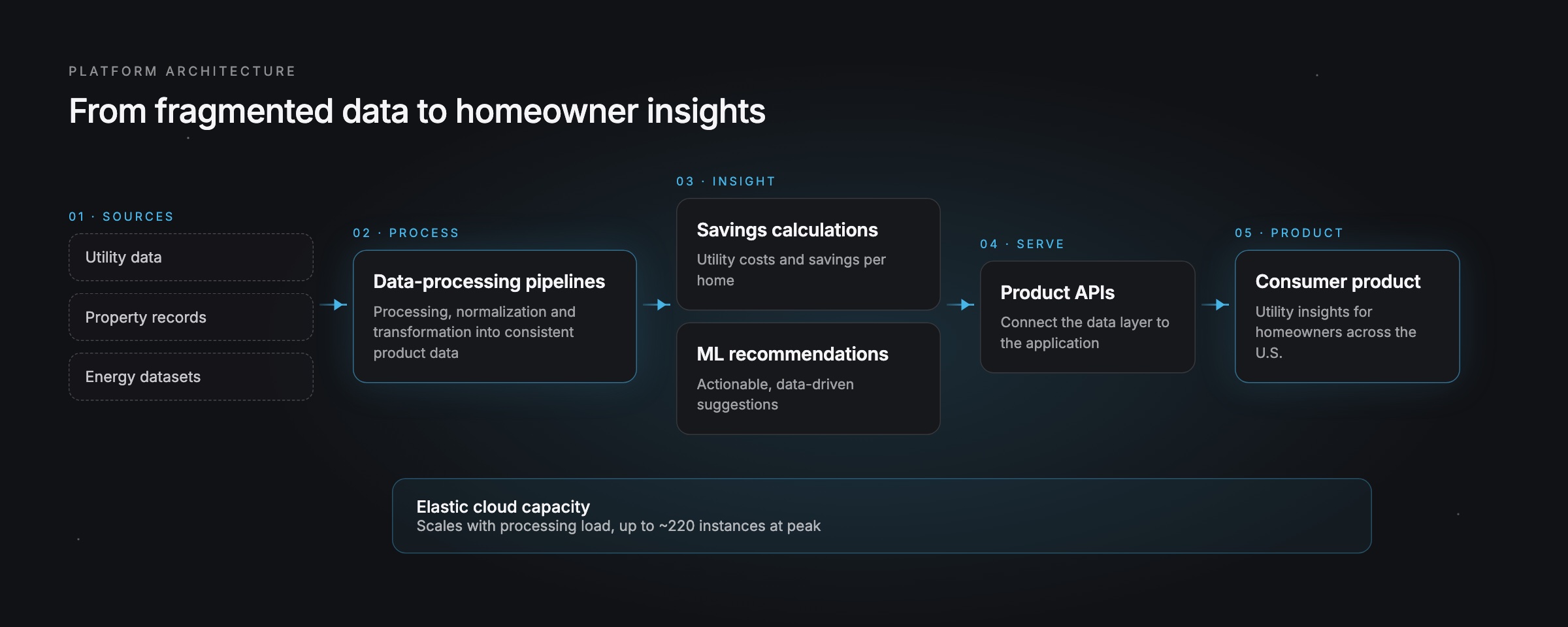
Data Processing and Normalization
The foundation was a set of data-processing pipelines designed to turn fragmented utility and property information into usable product data.
These pipelines supported the processing and transformation required to work with different datasets and prepare information for downstream calculations and product functionality.
This created the data foundation needed to support utility insights across a national property footprint.
Product APIs and Application Integration
Processed information needed to move beyond the data layer and become accessible to the consumer-facing product.
Product APIs connected the underlying data capabilities with application functionality, making utility and savings information available to the product experience.
This ensured that the platform wasn't simply processing information in isolation. It was turning that processing capability into something consumers could use.
Machine-Learning-Driven Recommendations
The next layer focused on making the information meaningful.
Machine-learning-driven recommendations helped translate utility and savings data into actionable insights.
By connecting the underlying data capabilities with recommendation logic, UtilityScore could deliver more useful information to homeowners.
Scaling Infrastructure Without Scaling the Organization at the Same Rate
UtilityScore needed infrastructure capable of handling workloads far beyond what a small startup team could support with fixed computing capacity.
Rather than building a large permanent engineering organization, the approach centered on strong technical ownership, a focused group of senior engineers, and flexible cloud capacity.
At peak processing loads, the cloud infrastructure scaled to approximately 220 instances.
This allowed the platform to accommodate substantial processing requirements without requiring the engineering organization to grow at the same rate.
The model combined a lean engineering core with the ability to introduce additional infrastructure capacity and specialized expertise when delivery milestones demanded it.
The Hard Problem: Balancing Data Scale, Processing, and Cost
The hardest part wasn't simply processing millions of records. It was making the different parts of the platform work together reliably.
Utility and property data needed to be normalized before they could support savings calculations and recommendation logic. Those results then needed to be accessible through product APIs.
Each layer depended on the quality and availability of the information produced by the preceding layer.
At the same time, processing requirements could increase substantially as the platform worked across its national coverage.
The engineering challenge was to accommodate these workloads while keeping infrastructure usage and engineering capacity aligned with actual demand.
Scaling to approximately 220 cloud instances at peak processing load demonstrated the infrastructure requirements behind the platform.
The Results: A Platform Built for National Coverage
UtilityScore established the engineering foundation needed to support a consumer utility intelligence product at national scale.
The platform brought together data-processing pipelines, product APIs, and machine-learning-driven recommendations to turn fragmented information into useful consumer insights.
By the Numbers
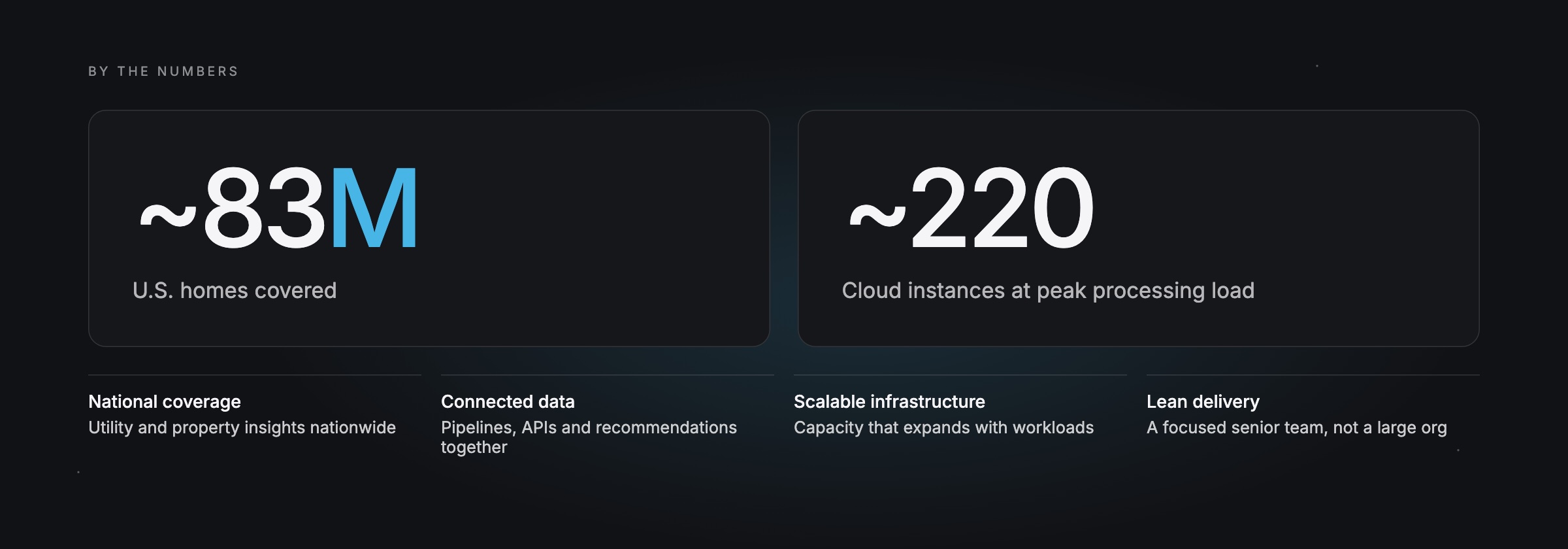
- ~83 Million U.S. homes covered.
- ~220 cloud instances at peak processing load.
What the Platform Delivered
- National-scale coverage: Support for utility and property insights across approximately 83 million U.S. homes.
- Connected data capabilities: Processing pipelines, product APIs, and recommendation capabilities working together.
- Scalable infrastructure: Cloud capacity that could expand to accommodate demanding processing workloads.
- Lean engineering delivery: Technical leadership and a focused engineering team supporting a platform with substantial infrastructure requirements.
Why This Matters
Building a product for millions of properties requires more than adding engineers or throwing more infrastructure at the problem.
It requires an architecture that can handle fragmented data, support demanding processing workloads, and deliver useful results through a product people can actually use.
UtilityScore demonstrates how strong technical ownership, scalable data engineering, and flexible infrastructure capacity can help a startup pursue a national-scale product without building a disproportionately large engineering organization.
Have a technically ambitious product to build?
Let's talk about how Infinite Build can help turn complex engineering requirements into platforms built to scale.