Infinite Build
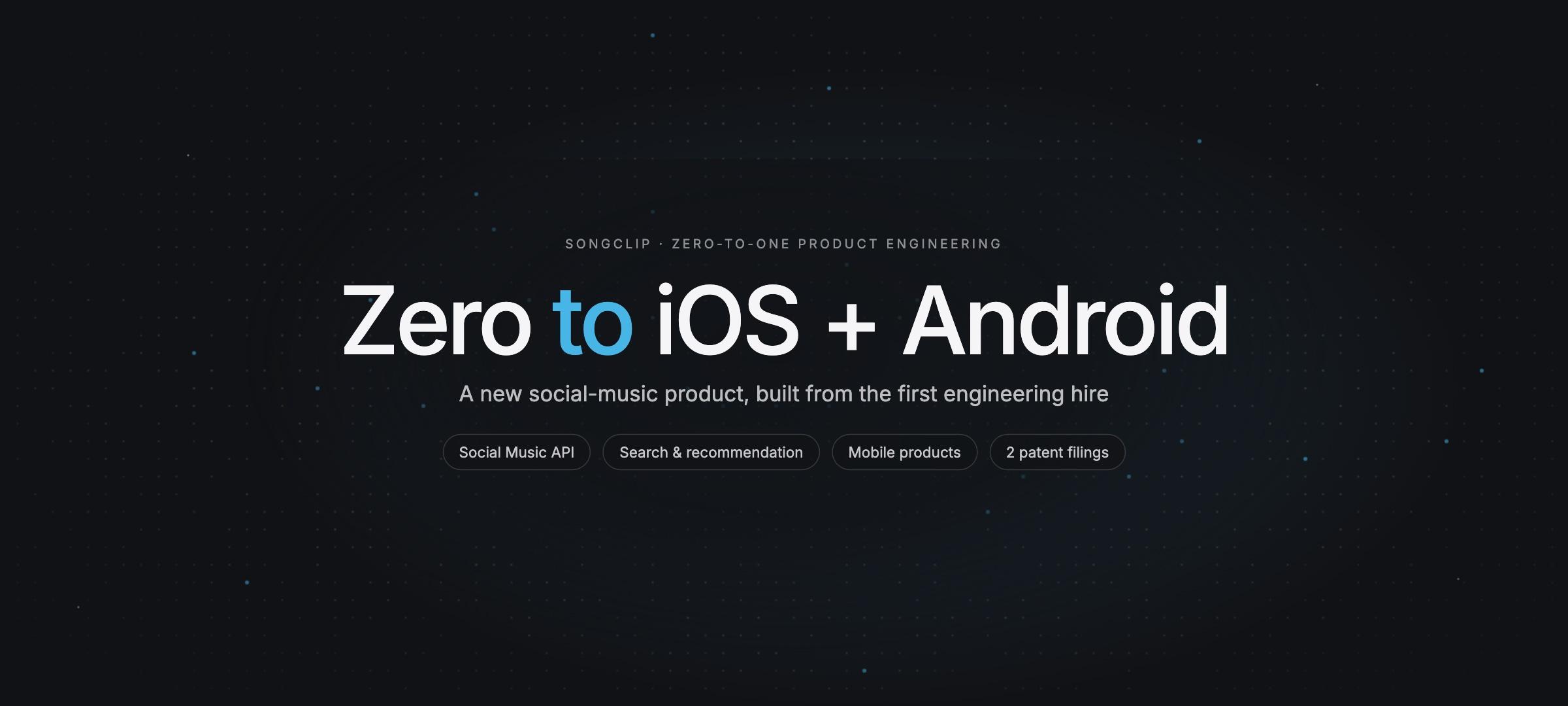
Zero-to-One Product Engineering
SONGCLIP · CASE STUDY
Building the engineering foundation for a new product category at the intersection of music, search, recommendation, mobile, and social platforms.
Songclip set out to build something that didn't have an established playbook: a social-music product bringing together music discovery, search, recommendation, mobile experiences, and social platforms.
The founders had an ambitious product vision, but turning that vision into a working product required more than development capacity. It required a technical foundation, a clear engineering direction, and the ability to turn an unfamiliar product concept into something a team could actually build and evolve.
Omar, now CTO of Infinite Build, joined Songclip as its first engineering hire and Head of Engineering. He translated the founders' vision into a technical architecture, led the development of a large-scale Social Music API, and oversaw the mobile products built on top of it for iOS and Android.
SONGCLIP CASE STUDY
Building a New Social-Music Product From the Ground Up
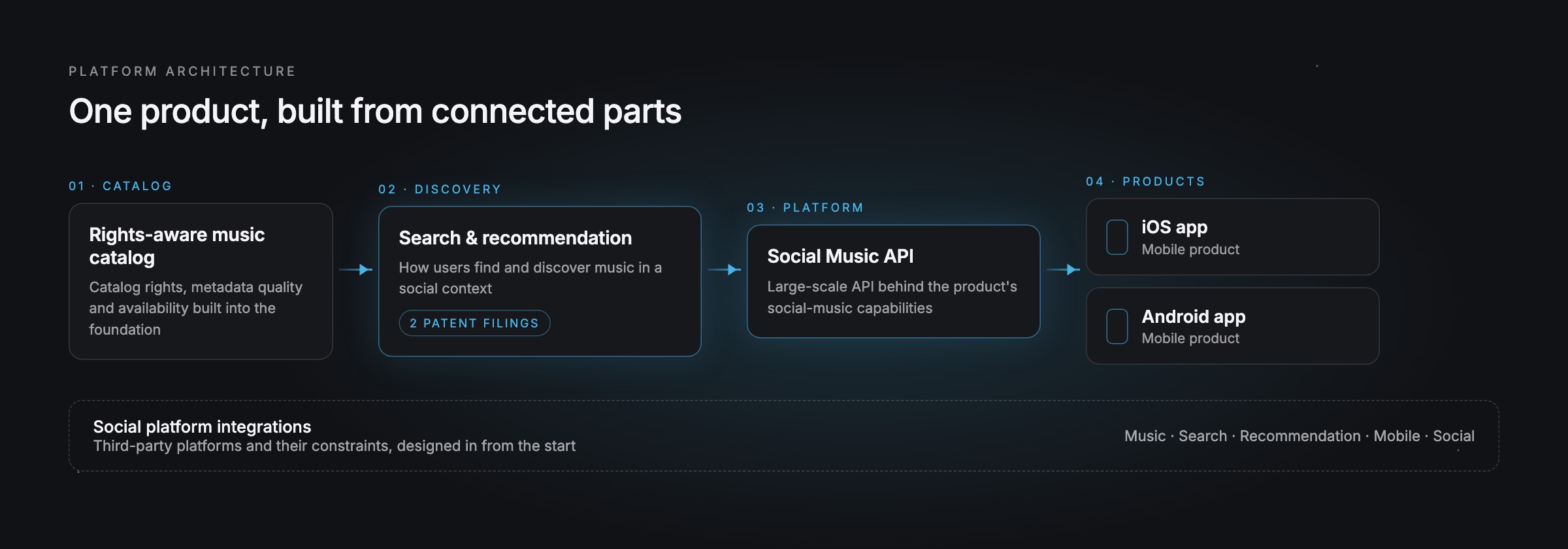
Songclip was developing a product category without an established playbook. It brought together several areas of engineering that each introduced their own requirements: music catalogs, search, recommendation, mobile applications, and social platform integrations.
The challenge was making these different pieces work together as one coherent product.
From the beginning, the company needed an engineering foundation that could support the product vision while giving the team room to build, test, and iterate.
THE CHALLENGE
Turning an Ambitious Product Idea Into an Engineering System
Building a social-music product involved more complexity than simply making music searchable or available through a mobile application.
Music discovery depends on the quality and structure of the underlying catalog, the relevance of search results, and the ability to surface recommendations that make sense in a social context.
Songclip needed to bring these capabilities together while also accounting for the constraints of mobile platforms and third-party integrations.
1. Working With Rights-Aware Music Catalogs
Music products operate within a more complex content environment than many conventional applications.
Catalog rights, metadata quality, and the availability of music information all influence how content can be represented and used within a product.
Songclip needed to account for these considerations as part of its technical foundation rather than treating the music catalog as a simple collection of searchable records.
2. Making Music Search and Discovery Work
Search and recommendation were central to the product experience.
Users needed a way to discover music, and the platform needed to support the underlying search and recommendation capabilities that made discovery possible.
This meant translating the product's discovery experience into engineering components that could be developed and improved independently while remaining part of the larger platform.
3. Connecting Mobile and Social Platforms
The product also needed to work across mobile experiences and social platforms.
Supporting iOS and Android introduced additional product and engineering requirements, while third-party platform integrations added their own constraints.
The challenge was to bring these different pieces together without losing sight of the overall product experience.
4. Establishing the Right Technical Foundation
Because the product category had no established playbook, the founders needed to make important technical decisions early.
The architecture needed to support the product vision while giving the engineering team a foundation it could build on as the product evolved.
Getting that foundation right was critical. The team needed to turn an ambiguous idea into clearly defined engineering work without committing prematurely to the wrong structure.
WHAT CHANGED
Turning the Founders' Vision Into a Technical Architecture
Omar, now CTO of Infinite Build, joined Songclip as its first engineering hire and Head of Engineering.
His role was to translate the founders' product vision into a technical architecture and lead the engineering work required to bring the product to life.
Rather than focusing on a single part of the product, he worked across the platform and the mobile products built on top of it.
Designing a Large-Scale Social Music API
A central part of the work was leading the design of a large-scale Social Music API.
This provided the technical foundation for the product's social-music capabilities and the mobile experiences built around them.
The API was a key part of turning the broader product concept into an engineering system that could support the company's ambitions.
Leading iOS and Android Product Development
The Social Music API was complemented by mobile products for both iOS and Android.
Omar led the engineering work across these products, helping translate the platform's capabilities into mobile experiences.
This required coordinating the underlying platform work with the products being built on top of it, rather than treating mobile development and platform engineering as separate efforts.
Building Search and Recommendation Capabilities
Search and recommendation were among the hardest parts of the product to develop.
They were central to how Songclip intended users to discover music, and required dedicated engineering work to turn the product's discovery vision into working technology.
This work ultimately led to two patent filings, with Omar named as an inventor, for innovations in how the product surfaced and recommended music.
HOW THE TEAM WAS STRUCTURED AND SCALED
Establishing the First Engineering Function
Songclip represents the earliest-stage version of the engineering model that Infinite Build follows today.
As the first engineering hire and Head of Engineering, Omar helped establish the technical direction and engineering foundation from the beginning.
The founders needed someone who could work across the product rather than focusing on a narrowly defined engineering function.
That meant moving between product, platform, mobile, search, and recommendation as the work required.
Working Across the Entire Product
At this stage, separating responsibilities too rigidly would have made it harder to move quickly.
The product required decisions across several connected areas, and those decisions needed to remain aligned with the founders' vision.
Omar worked across these areas, helping translate product requirements into engineering priorities and ensuring that the different components developed as part of one product.
Building Without Unnecessary Organizational Overhead
The founders needed the right technical leadership and engineering capabilities to establish the product, without having to build every function in-house before the business was ready.
The focus was on creating the engineering foundation and bringing the right people around the work as the product developed.
This allowed the team to move from concept toward working iOS and Android products without losing sight of the larger technical direction.
THE HARD PROBLEM
Building Search and Recommendation Technology for a Product Without an Established Playbook
The most difficult engineering challenge was building search and recommendation technology for social music discovery from the ground up.
Music discovery brought together several interconnected requirements: music catalog rights, metadata quality, search relevance, recommendation, and the constraints of mobile and social platforms.
These weren't isolated features. They were connected parts of the product experience.
The team needed to translate the founders' vision into technical components that could support how users would find and discover music.
There was no established product blueprint to follow. The engineering work involved designing the foundation, developing the necessary capabilities, and turning an ambitious concept into something that could actually be shipped.
The significance of this work extended beyond the initial product development. It led to two patent filings for innovations in how the product surfaced and recommended music, with Omar named as an inventor.
QUANTIFIED OUTCOME
From Product Concept to Shipped Mobile Products
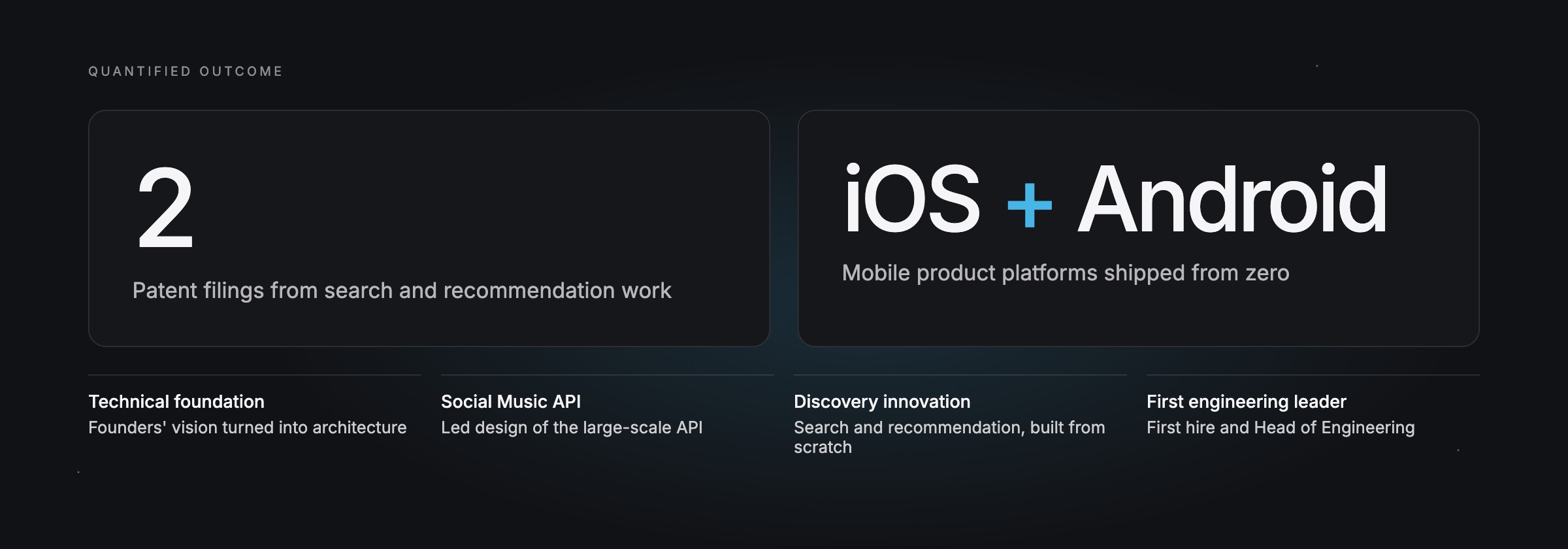
- 2 patent filings from search and recommendation work.
- iOS + Android mobile product platforms shipped from zero.
What the Work Established
- A technical foundation: Translated the founders' product vision into an engineering architecture.
- A large-scale Social Music API: Led the design of the API supporting the social-music product.
- Mobile products: Built the engineering foundation for products shipped on both iOS and Android.
- Search and recommendation innovation: Engineering work that resulted in two patent filings, with Omar named as an inventor.
- First engineering leadership: Established technical direction as the company's first engineering hire and Head of Engineering.
WHY THIS MATTERS TO AN INFINITE BUILD CUSTOMER
At the earliest stage of a startup, the biggest engineering risk isn't necessarily writing code too slowly. It's building the wrong foundation and discovering the consequences when the product has already grown around it.
Songclip demonstrates the value of bringing experienced technical leadership into a startup early enough to shape the architecture, establish engineering direction, and turn an ambitious product concept into something a team can execute.
The work went beyond building features. It involved translating an unfamiliar product idea into a technical foundation, leading platform and mobile development, and solving difficult search and recommendation problems along the way.
That's the role Infinite Build aims to play for early-stage companies: bringing technical leadership and engineering execution together so founders can move from an idea to a product without losing sight of what comes next.
Building something that doesn't have an established playbook?
Let's talk about how Infinite Build can help turn your product vision into an engineering foundation.