Infinite Build
Engineering Modernization
SHOPPINGGIVES · CASE STUDY
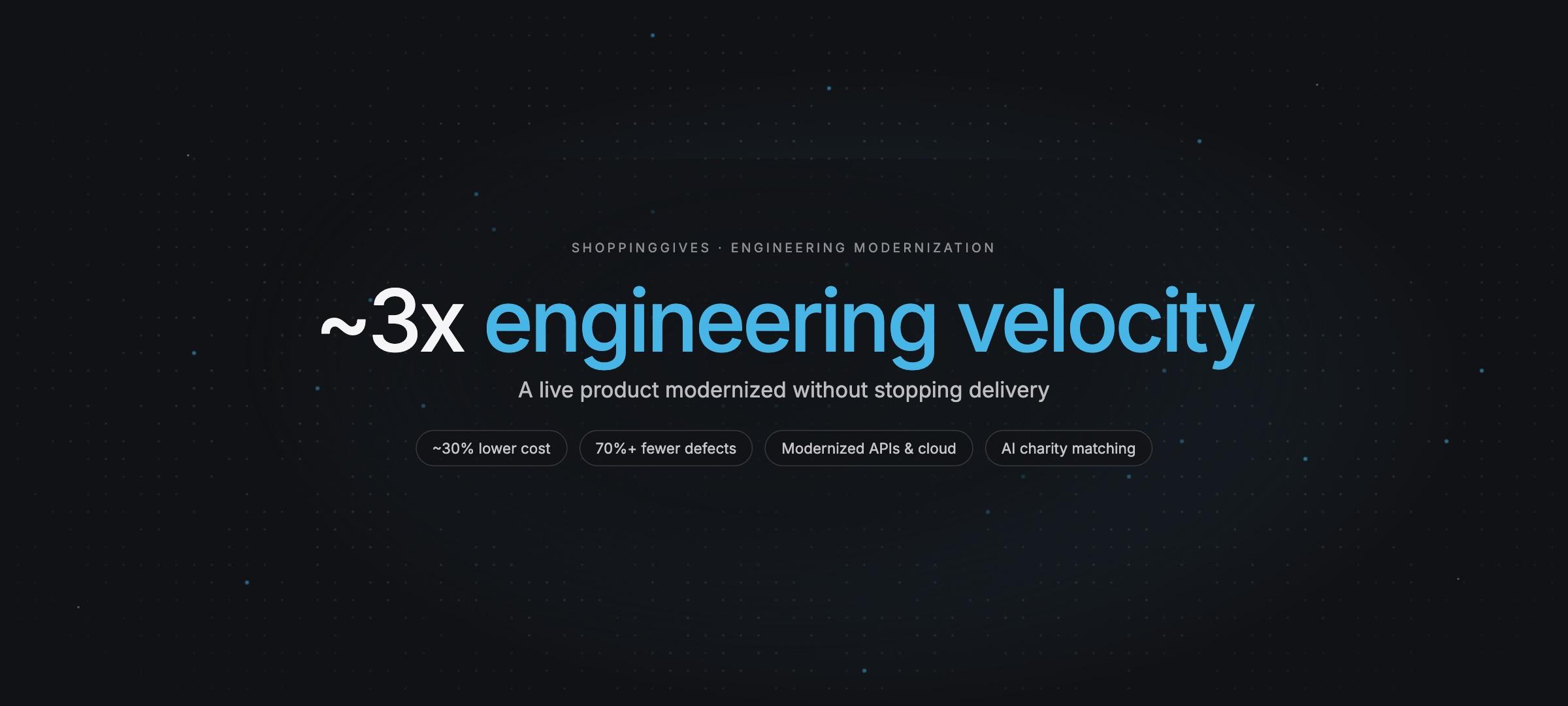
Rebuilding engineering for approximately 3x velocity, lower costs, and fewer defects — without stopping product delivery.
ShoppingGives already had a working product. The challenge was that its engineering operation had become slow, expensive, and unpredictable. The business needed to improve delivery speed, reduce engineering costs, and raise product quality without pausing development or disrupting existing customer commitments.
Modernizing an established product required more than introducing new technology. It meant improving the engineering foundation while continuing to deliver the features the business needed.
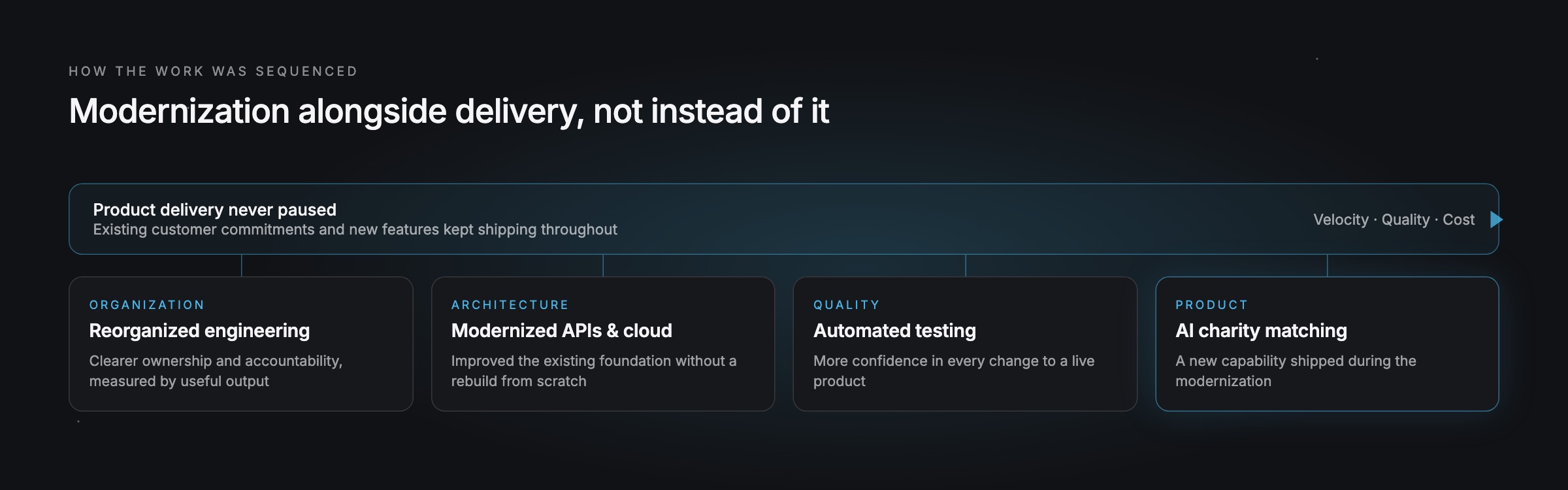
As CTO and Head of Engineering, Omar, now CTO of Infinite Build, reorganized the engineering function, modernized the product's APIs and cloud architecture, and introduced stronger automated testing. Alongside this work, the team shipped an AI-driven charity-matching capability.
The result was a more productive engineering operation, with approximately 3x engineering velocity, 30% lower engineering costs, and more than 70% fewer defects.
SHOPPINGGIVES CASE STUDY
Improving the Engineering System Behind an Existing Product
ShoppingGives didn't need to start over. It needed to make its existing engineering operation work better.
The product was already serving its purpose, but the way it was being built and maintained was creating friction. Engineering delivery had become expensive and unpredictable, while product quality and development speed needed improvement.
The challenge was to address these problems without treating modernization as a separate project that required stopping everything else.
The engineering foundation, team structure, and delivery process all needed to improve together.
THE CHALLENGE
Modernizing a Live Product Without Slowing the Business
Modernizing an existing product introduces constraints that don't exist in a greenfield project.
There are existing customers, ongoing commitments, established product behavior, and technical decisions that cannot simply be discarded. Improvements need to happen while the business continues operating and new features continue to ship.
ShoppingGives faced several connected engineering challenges.
1. Improving Engineering Velocity
The existing engineering operation had become slow and unpredictable.
Development work needed to move more efficiently, with clearer ownership and fewer obstacles between engineering effort and shipped product improvements.
Simply adding more engineers wouldn't necessarily solve the underlying problem. The way the engineering function was organized and operated also needed attention.
2. Modernizing the Existing Architecture
The product's APIs and cloud architecture needed modernization.
This required improving the underlying technical foundation while working within an existing product rather than replacing everything at once.
The challenge was deciding what needed to change, how to approach those changes, and how to sequence the work without creating unnecessary disruption.
3. Improving Product Quality
Engineering speed means little if it comes at the expense of reliability.
Existing defects were another source of friction, making stronger testing and quality practices an important part of the modernization effort.
The team needed better automated testing to improve confidence in changes and reduce the number of defects reaching the product.
4. Reducing Engineering Costs
The business needed engineering to become more cost-efficient without sacrificing delivery capacity or product quality.
That meant looking beyond the size of the engineering team and improving how engineering resources were organized and used.
The objective was to get more useful output from the engineering operation rather than simply increase headcount.
WHAT CHANGED
Reorganizing Engineering Around Better Ownership and Delivery
As CTO and Head of Engineering, Omar, now CTO of Infinite Build, led changes across the engineering function and the product's technical foundation.
The work focused on improving how engineering was organized, modernizing the underlying architecture, and strengthening the practices used to build and maintain the product.
Reorganizing the Engineering Function
The first part of the work was improving the engineering operating structure.
The team was reorganized around clearer ownership, helping establish greater accountability for product development and delivery.
Rather than treating engineering capacity as the primary measure of productivity, the focus shifted toward useful output: how effectively the team could deliver product improvements while maintaining quality.
Modernizing APIs and Cloud Architecture
The product's APIs and cloud architecture were modernized as part of the broader engineering improvement effort.
This work addressed the technical foundation behind the existing product, rather than treating modernization as a reason to rebuild everything from scratch.
Improving these areas helped support the wider objective of making engineering delivery more efficient and predictable.
Introducing Stronger Automated Testing
Automated testing became another important part of the modernization effort.
The goal was to improve confidence in engineering changes and strengthen product quality while development continued.
This was particularly important for a live product, where architectural changes and new feature development needed to happen without introducing unnecessary defects.
Shipping New Product Capabilities Alongside Modernization
Modernization wasn't allowed to become an isolated engineering exercise.
While the team improved the product's architecture, engineering structure, and testing practices, it also shipped an AI-driven charity-matching capability.
This demonstrated that the team could improve the engineering foundation and continue delivering new product functionality at the same time.
HOW THE TEAM WAS STRUCTURED AND SCALED
Optimizing Engineering Capacity Around Useful Output
ShoppingGives provides a clear example of the engineering model Infinite Build uses: a strong core team with flexible engineering capacity around it.
The objective wasn't to maximize headcount. It was to maximize useful output while balancing velocity, quality, and cost.
A core engineering team maintained ownership of the product, while additional capacity could be introduced to fill specific gaps or accelerate defined initiatives.
This approach allowed the business to align engineering resources with actual delivery requirements rather than maintaining unnecessary permanent capacity.
Keeping Product Ownership Centralized
A strong internal core remained responsible for the product and its direction.
This was important during modernization because architectural changes, testing improvements, and new feature development all needed to remain coordinated.
Clear ownership helped ensure that additional engineering capacity contributed to the same objectives without fragmenting responsibility for the product.
Flexibility Without Losing Delivery Discipline
The operating model was designed around what the business needed to accomplish.
Engineering capacity could flex around specific requirements, while the core team maintained continuity and ownership.
The measure of success was not how many developers were involved. It was whether the organization could deliver faster, improve quality, and reduce costs together.
THE HARD PROBLEM
Improving Architecture, Quality, and Delivery Without Stopping Development
The hardest part of the ShoppingGives engagement was sequencing modernization work on a live product.
The engineering team couldn't simply stop delivering new features to focus entirely on architecture and testing.
Existing customer commitments remained, while the business continued to need product improvements.
That created a balancing problem.
Some parts of the engineering foundation needed modernization, but changing too much at once could introduce disruption. Testing needed improvement, but the team still had to maintain delivery momentum. Engineering costs needed to decrease, but the business couldn't afford to lose the capacity required to deliver.
The work required coordinating these priorities rather than treating them as separate initiatives.
By reorganizing engineering, modernizing APIs and cloud architecture, and introducing stronger automated testing while continuing to ship new capabilities, the team addressed the underlying engineering problems without putting product delivery on hold.
QUANTIFIED OUTCOME
Faster Delivery. Lower Costs. Better Quality.
The modernization effort produced improvements across three important measures of engineering performance.
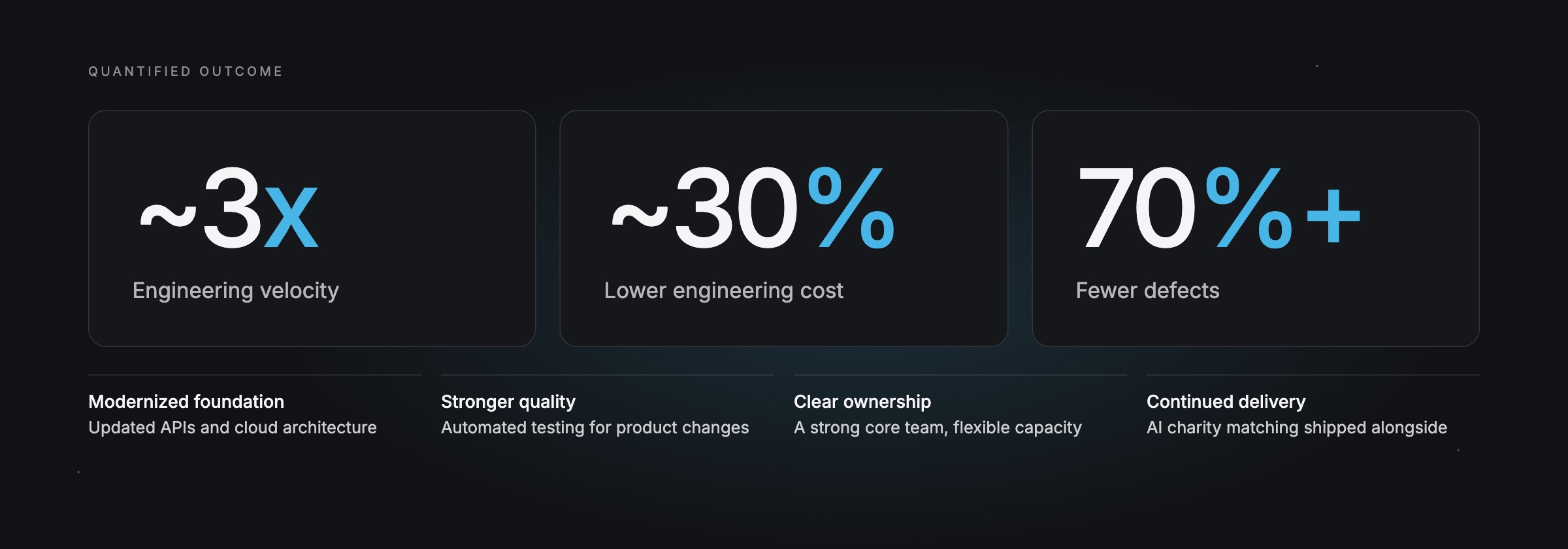
- ~3x engineering velocity.
- ~30% lower engineering cost.
- 70%+ fewer defects.
What Changed
- Higher engineering velocity: Approximately three times the previous engineering delivery speed.
- Lower engineering costs: Approximately 30% reduction in engineering costs.
- Improved product quality: More than 70% fewer defects.
- Modernized technical foundation: Updated APIs and cloud architecture.
- Stronger quality practices: Automated testing introduced to improve confidence in product changes.
- Continued product development: An AI-driven charity-matching capability shipped alongside the modernization work.
WHY THIS MATTERS TO AN INFINITE BUILD CUSTOMER
Modernizing an existing product is one of the more difficult engineering challenges a growing business can face.
The product already has customers, the business still needs new features, and the engineering organization cannot simply stop operating while its foundations are improved.
ShoppingGives demonstrates that engineering velocity, cost, and quality don't have to be treated as competing priorities.
By improving the engineering structure, modernizing the technical foundation, and strengthening automated testing, the team improved all three while continuing to deliver new product capabilities.
That's the principle behind Infinite Build's approach: engineering should be measured by the value it delivers, the quality it maintains, and the cost at which it operates — not simply by the number of people on the team.
Need to modernize an existing product without stopping delivery?
Let's talk about how Infinite Build can help improve your engineering foundation while keeping your business moving.