Infinite Build
Carrier-Scale Security Infrastructure
OPTENET · CASE STUDY
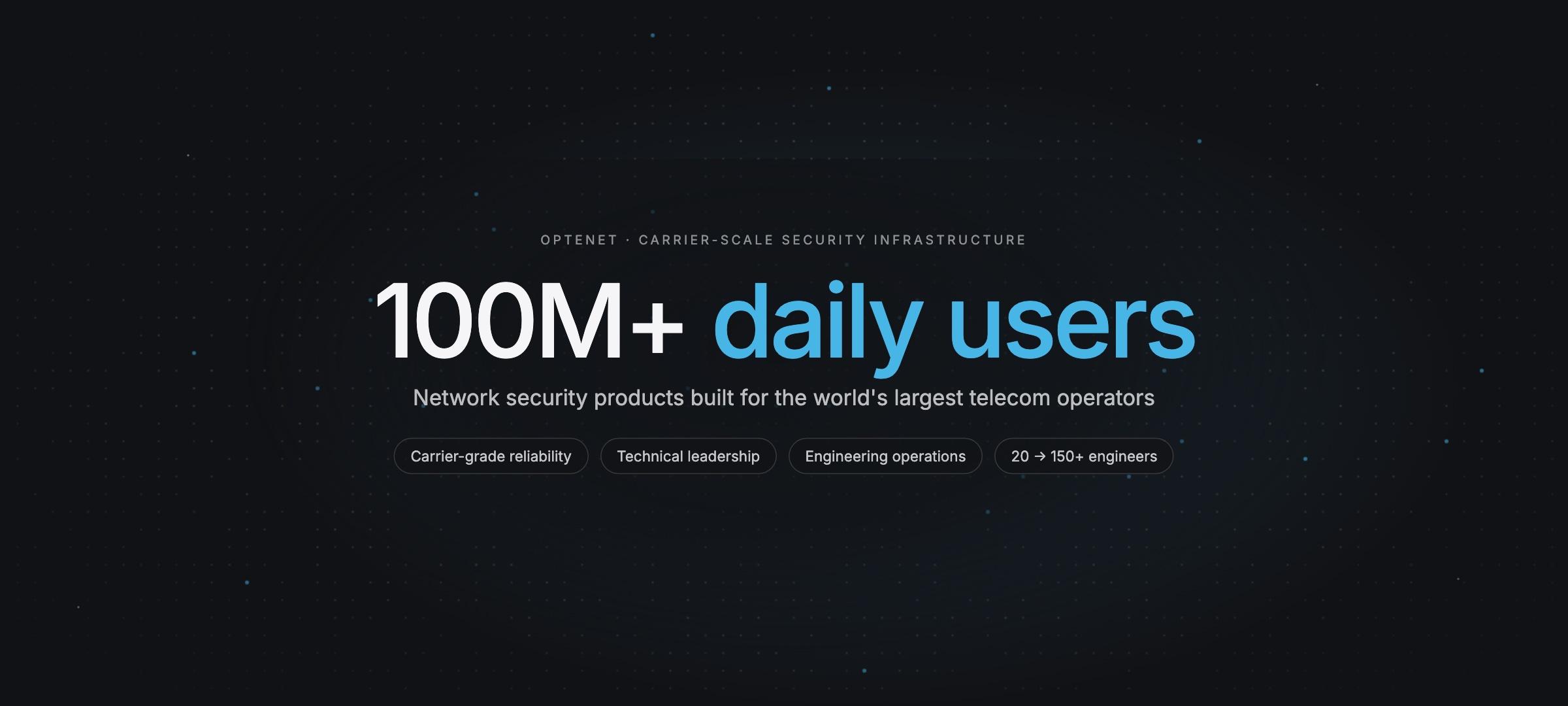
From a startup engineering team to a carrier-grade platform serving 100M+ daily active users.
Optenet built network security products for telecommunications operators. The challenge was never simply to ship features. The products needed to be dependable enough for some of the world's largest carriers to run on, supporting enormous traffic volumes in environments where reliability was essential.
What began as a startup engineering team evolved into a global engineering organization of more than 150 people, supporting a platform with over 100 million daily active users.
Omar, now CTO of Infinite Build, was a co-founder at Optenet and helped shape its product, engineering organization, and technical operations throughout that growth.
Project Overview
- Client: Optenet
- Industry: Telecommunications / Network Security
- Engagement: Product Engineering, Technical Leadership & Engineering Operations
- Platform Scale: 100M+ daily active users
- Engineering Growth: Approximately 20 to 150+ engineers globally
THE CHALLENGE
Building Security Products That Telecom Operators Could Depend On
Telecommunications infrastructure operates at a scale where reliability is critical. Network security products deployed by major operators must support enormous traffic volumes while operating in environments with little tolerance for downtime.
For Optenet, the challenge extended beyond developing a capable security product. The company needed to evolve its technology and engineering organization to meet the expectations of major international telecom operators.
This meant addressing several interconnected challenges.
Supporting Demanding Network Environments
Security products built for telecom operators face requirements that go beyond those of typical business applications.
They need to operate reliably under substantial traffic volumes and meet demanding operational expectations. Product development had to account for the environments in which these systems would be deployed and the importance of maintaining dependable service.
Evolving Beyond Startup-Scale Engineering
An early-stage engineering team can move quickly through close collaboration and relatively simple delivery processes.
As customer commitments grow, however, the complexity of product development and delivery increases. Optenet needed to transition from a startup engineering operation into an organization capable of supporting major international customers without losing execution speed.
Maintaining Technical Direction During Growth
Growing the engineering team introduced another challenge: maintaining consistent technical direction and product ownership.
The organization needed experienced engineering leadership, clear responsibilities, and delivery processes that could support multiple teams while keeping product development aligned with customer requirements.
WHAT CHANGED
Building the Product and Technology Organization Together
Omar, now CTO of Infinite Build, was a co-founder at Optenet and held senior engineering and operating leadership roles as the company scaled.
His involvement extended beyond individual product development decisions. He helped shape the engineering organization from an early stage and remained closely involved through its growth.
The focus was on building the technical and organizational foundations required to support a product serving major telecommunications operators.
Product and Platform Engineering
Optenet needed to develop network security products capable of meeting the demands of large telecom environments.
This required sustained technical leadership and an engineering organization capable of evolving the products while maintaining the reliability expected by enterprise customers.
The focus was not simply on delivering individual features. It was on developing and supporting a platform that major operators could depend on.
Technical Leadership and Architecture Ownership
As the organization grew, maintaining clear ownership of the product and its technical direction became increasingly important.
A core engineering group retained responsibility for product and architecture ownership, providing continuity as additional engineering capacity was introduced.
This helped the organization expand without allowing technical direction to become fragmented across a growing number of teams.
Engineering Delivery and Operational Processes
Product development at a larger scale requires more coordination, structure, and accountability.
Engineering leadership and delivery processes evolved alongside the organization, helping teams manage increasing customer commitments while maintaining execution discipline.
This allowed Optenet to grow its engineering capabilities without treating every new customer requirement as an isolated development effort.
HOW THE TEAM WAS STRUCTURED AND SCALED
Growing From 20 to More Than 150 Engineers Globally
One of the most significant parts of Optenet's journey was the expansion of its engineering organization.
The team grew from approximately 20 engineers to more than 150 globally.
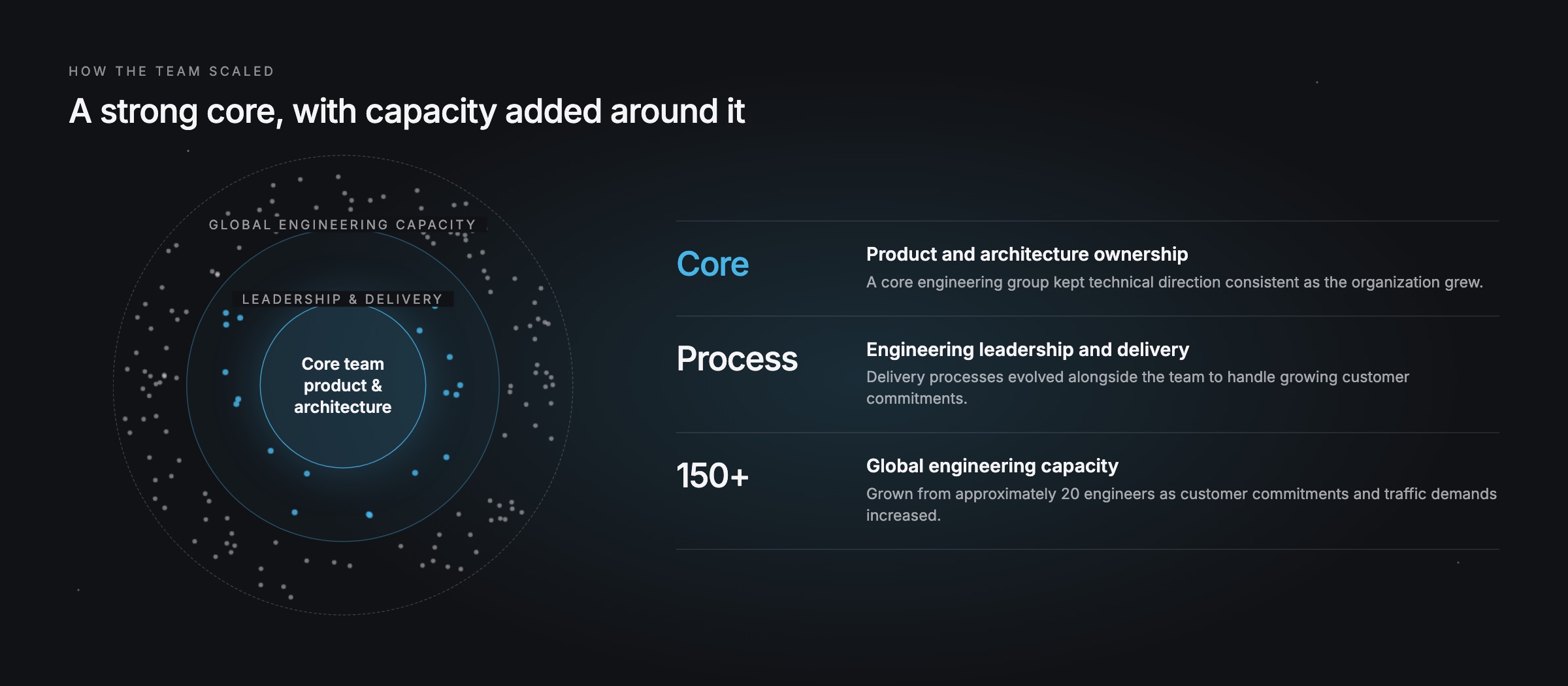
This growth was driven by the demands of the product, its expanding customer base, and the operational requirements of supporting major international telecom operators.
Rather than expanding headcount without structure, the organization maintained a core team responsible for product and architecture ownership while adding engineering capacity as customer commitments and traffic demands increased.
The approach required more than recruitment. It required building engineering leadership, establishing delivery processes, and maintaining a consistent technical direction across a much larger organization.
The result was an engineering organization capable of supporting a platform at significant global scale while continuing to develop and maintain its products.
THE HARD PROBLEM
Scaling the Platform and the Engineering Organization at the Same Time
Optenet's most demanding challenge was managing two forms of growth simultaneously.
The first was technical: building and maintaining network security infrastructure dependable enough for major telecommunications operators, with more than 100 million daily active users on the platform.
The second was organizational: growing from approximately 20 engineers to more than 150 globally without losing technical ownership, delivery discipline, or product direction.
These challenges were closely connected.
As the platform and customer commitments grew, the engineering organization needed greater capacity and stronger coordination. But adding engineers alone wouldn't solve the problem. The company also needed the leadership and operating structure to ensure that a larger team could continue delivering a coherent product.
At the same time, organizational growth couldn't come at the expense of the reliability expected by telecom customers.
The challenge was to evolve the product, technical leadership, and engineering organization together.
QUANTIFIED OUTCOME
Engineering and Platform Scale
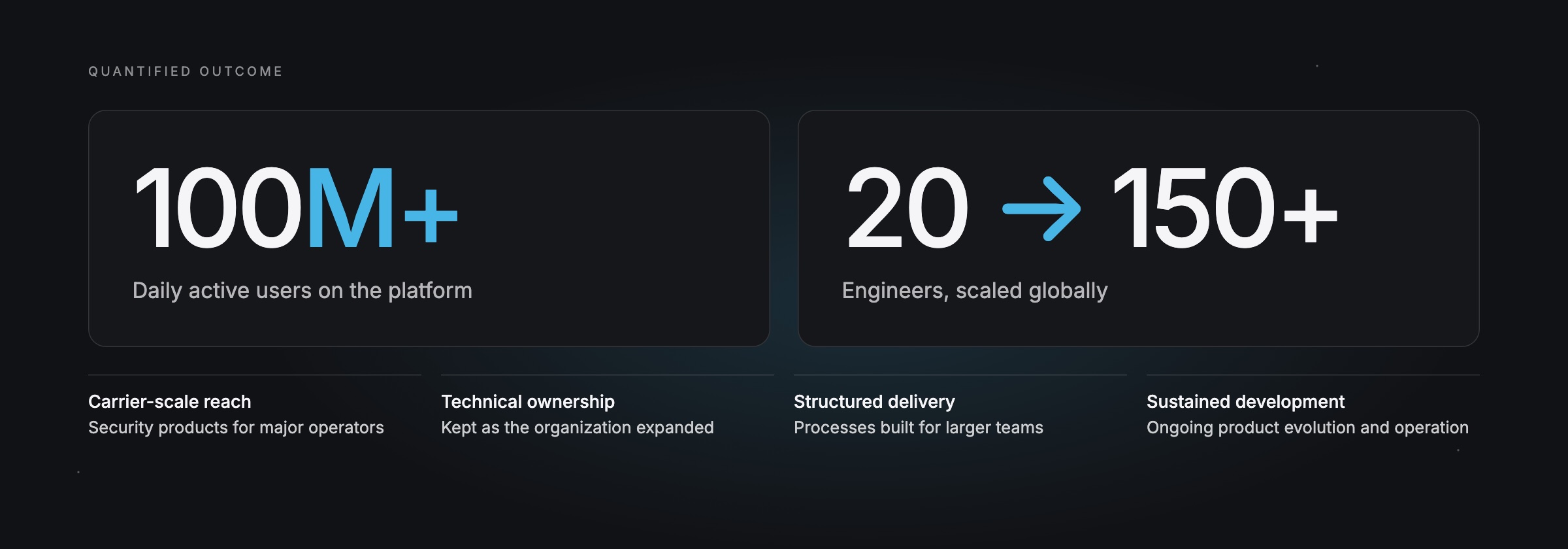
- 100M+ daily active users on the platform.
- 20 → 150+ engineers, scaled globally.
What the Growth Demonstrated
- Carrier-scale reach: Network security products supporting more than 100 million daily active users.
- Global engineering capacity: Growth from approximately 20 to more than 150 engineers.
- Stronger technical ownership: Product and architecture responsibilities maintained as the engineering organization expanded.
- Structured delivery: Engineering leadership and delivery processes developed to support larger teams and customer commitments.
- Sustained product development: An engineering organization built to support the ongoing development and operation of security products for major telecommunications operators.
WHY THIS MATTERS TO AN INFINITE BUILD CUSTOMER
Building an initial product is one challenge. Building an engineering organization capable of supporting that product as the business grows is another.
Optenet demonstrates what happens when technical leadership, product engineering, and organizational development are treated as connected responsibilities.
The experience helped shape how Infinite Build approaches engineering today: maintain a strong technical core, establish clear ownership, and scale engineering capacity around the actual needs of the business.
For companies facing the transition from an early-stage product to a platform with demanding enterprise customers, the lesson is straightforward: scaling requires more than additional developers. It requires the technical leadership and engineering structure to make that growth sustainable.
Building something that needs to scale beyond its initial team?
Let's talk about how Infinite Build can help you build the engineering foundation to get there.