Infinite Build
One site and one workflow for a growing video business
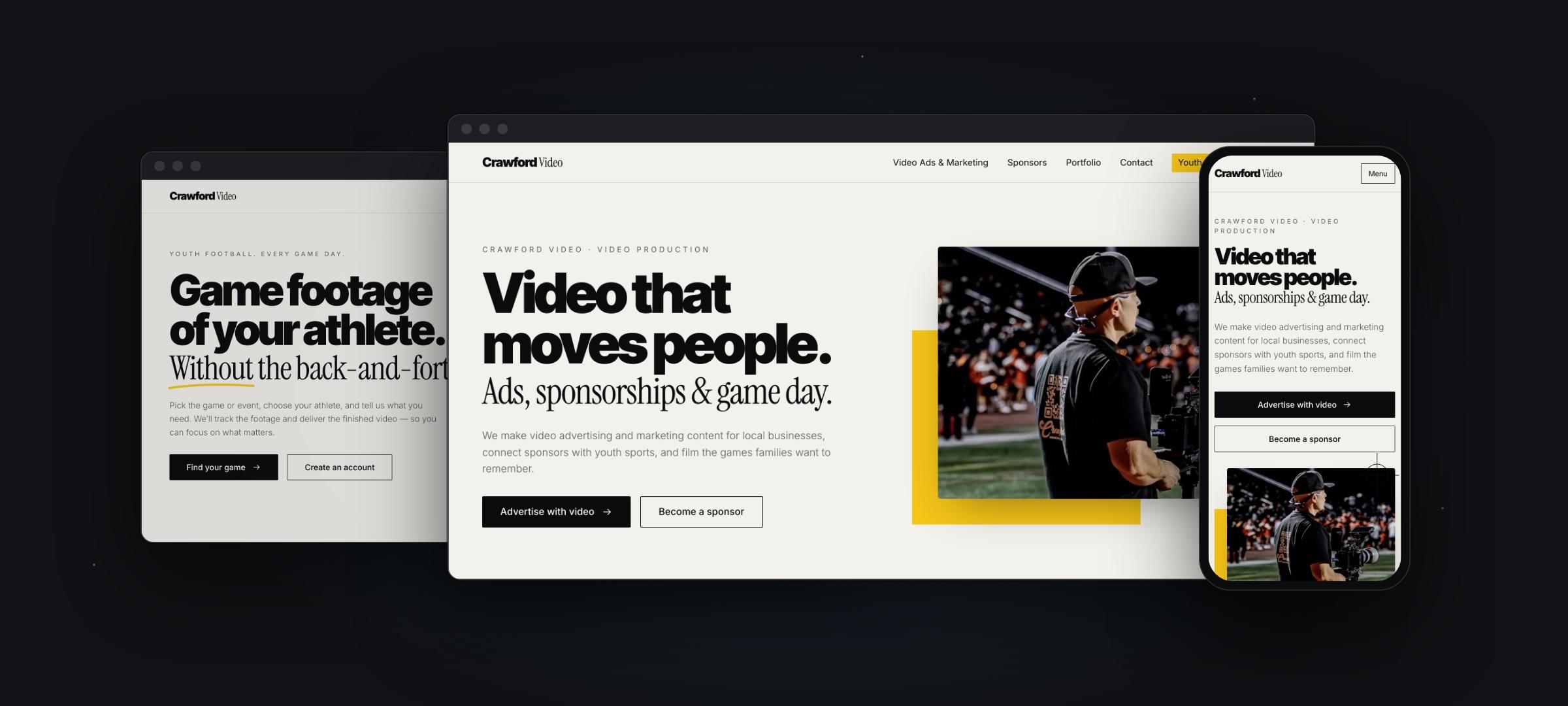
Crawford Video is a video production business. It makes ads and marketing content for local businesses, connects sponsors with youth sports, and films the games families want to keep. We built its website and the platform behind it. That includes Youth Sports, the system families use to order and receive game footage of their athletes.

THE CHALLENGE
Crawford Video's work spans three audiences: businesses buying video, businesses sponsoring youth sports, and families who want footage of a particular game. All three were handled by hand.
The game-footage side carried the most friction. Requests came in by text, phone call and DM, and each one left the same questions open: which game, which athlete, what footage, who asked, and whether it had been edited or delivered. Every unanswered question turned into another follow-up message.
The business needed one site that could sell all three services. Behind it, it needed a structured workflow to replace the inbox.
WHAT WE BUILT
A business site for advertisers and sponsors
The public site presents Crawford Video's services: video ads and commercials, social media content, brand and promotional films, and event coverage. Every service starts with an inquiry rather than a fixed-price checkout, because those projects are scoped one at a time.

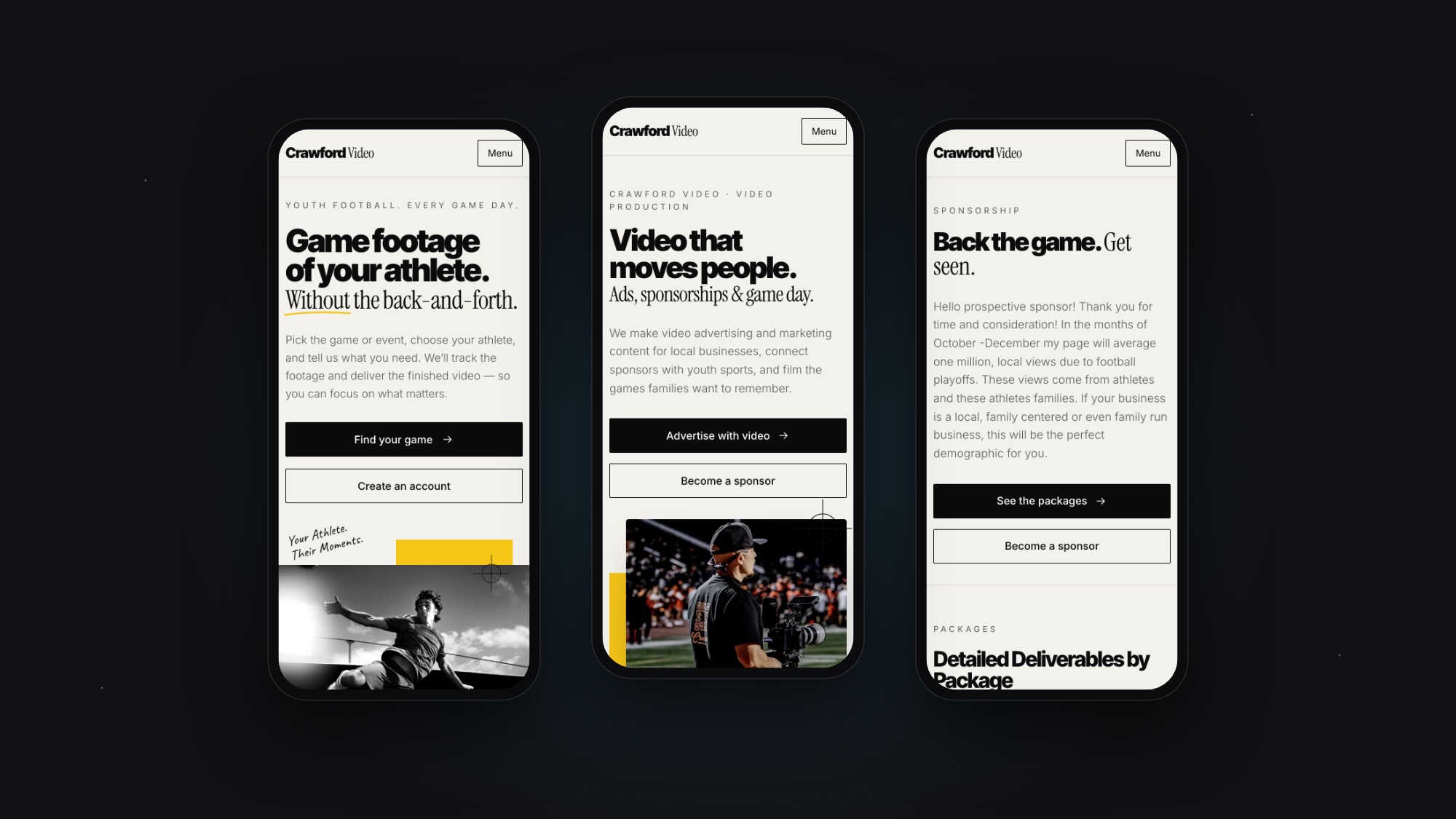
The sponsors page sets out the Gold, Silver and Bronze packages and their deliverables, with a comparison table. When a business chooses a package, the form records its choice, so every sponsorship inquiry arrives with that context attached. Inquiries go to an admin inbox. Submissions are rate-limited, and an email alert goes out when a new one arrives.

The portfolio is managed from the admin panel by adding YouTube or Vimeo links, so the team can publish new work without a code change.
Youth Sports: game footage without the back-and-forth
Youth Sports turns footage requests into a defined workflow. The videographer schedules games. Families browse the schedule, save the athletes they follow, choose a game, and describe what they want: a specific moment, a highlight reel or the full game.

Each request lands in an organized production queue. The videographer can filter it by game, sport, status, customer and athlete. When a video is finished, it is uploaded privately to that specific request. The customer gets a notification and can watch or download the video from their account. Delivered files sit in a private storage bucket and are served only through short-lived signed links to the owner. Emails link to sign-in-protected pages, never to the video files themselves.

Football was the first use, but the platform is sport-agnostic. Games, participants and terminology are modeled so that team sports, individual matches and multi-athlete events all fit without a redesign.
Payments that can't drift out of sync
Clips are paid for online through Stripe Checkout. The admin sets a price per clip type, and the database copies that price onto each order when it is placed, so a later price change never alters an existing order. Only Stripe's verified webhook can mark an order paid or refunded, and only after the session, amount and currency match the order. A mismatch is held for review rather than accepted. Duplicate webhook events are ignored, and work can't start on an unpaid or refunded order unless an admin waives payment.
Privacy built in
Many customers are families ordering footage of children, so privacy was a design constraint from the start. Row-level security in Postgres enforces access: customers see only their own athletes, requests and videos. Analytics stay off until a visitor consents. Names, emails, athlete details, messages and identifiable URLs are stripped from events before anything is sent.
Built for phones
Most families will find the site from a link on their phone, so every page was designed to work on mobile, from browsing the schedule to watching a delivered video.
HOW WE BUILT IT
- Extended the existing platform rather than starting over. We built the Crawford Video business site on top of the existing Youth Sports app, in the same codebase, with the same database and the same accounts. Its games, athletes, requests and private delivery kept working unchanged.
- Additive, verified migrations. Every schema change was additive and was applied by a setup script that confirms the target project, runs each migration in a transaction and checks tables, row-level security and storage afterwards.
- Admin-editable content. Sponsors, portfolio items, pricing, sports and games are all managed from the admin panel, so day-to-day changes don't need an engineer.
- Integrations that degrade safely. If email or analytics aren't configured, the app sends nothing and never claims it did.
STACK
Next.js (App Router), React, TypeScript, Supabase (Auth, Postgres with row-level security, private Storage, Realtime), Stripe Checkout, Resend, Mixpanel, Vercel.